
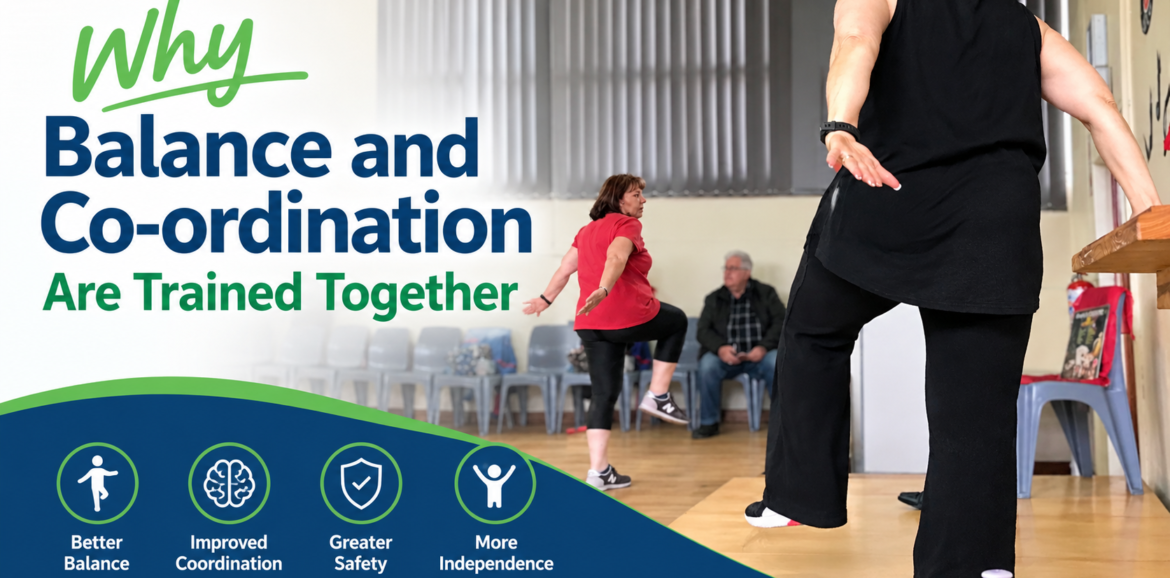
At first glance, balance and co-ordination can seem like separate skills — one about staying upright, the other about moving smoothly. But from a physiological standpoint, they’re deeply intertwined, and training them together isn’t just a stylistic choice in senior fitness classes — it reflects how the body actually maintains stability.
The systems behind balance
Balance isn’t controlled by a single sense or muscle group. It depends on the integration of three main systems:
- The vestibular system (inner ear), which detects head position and movement
- The visual system, which provides spatial reference points
- Proprioception, the body’s sense of where its joints and limbs are in space, fed by receptors in muscles, tendons, and joints
The brain — primarily the cerebellum, along with parts of the brainstem and cerebral cortex — continuously combines input from all three systems to make micro-adjustments in posture and muscle tension. This process is called sensory integration, and it happens largely below conscious awareness.
Where co-ordination fits in
Co-ordination is the nervous system’s ability to sequence muscle contractions accurately and in the right timing — arms and legs moving in relation to each other, weight shifting smoothly from one side to the other. This relies on many of the same neural pathways used for balance, particularly the cerebellum, which acts as a kind of timing and error-correction center for movement.
Because balance and co-ordination share this neural infrastructure, exercises that combine them — such as stepping patterns to music, weight shifts paired with arm movements, or directional changes — train the systems as they’re actually used, rather than in isolation.
Why this matters more with age
Aging affects all three balance inputs to varying degrees. Vestibular sensitivity tends to decline, visual acuity and depth perception often change, and proprioceptive feedback from joints can become less precise, particularly where conditions like arthritis are present. Research on falls in older adults consistently identifies impaired balance and slowed neuromuscular response — not muscle weakness alone — as leading contributors to fall risk.
This is why balance training in isolation, such as simply standing on one leg, has real value, but combining it with co-ordinated movement offers a closer match to the demands of daily life. Walking, turning to answer someone, reaching while shifting weight, or navigating stairs all require balance and co-ordination to function simultaneously, not as separate skills switched on and off.
The evidence for combined training
Studies on structured exercise interventions for older adults — including multicomponent programs incorporating balance, co-ordination, strength, and endurance — have shown measurable improvements in functional mobility and reductions in fall incidence, particularly when balance work is paired with dynamic, co-ordinated movement rather than static holds alone. Programs that isolate a single component tend to show narrower benefits, improving that specific skill without transferring meaningfully to real-world stability.
Practical implications for class design
This is the rationale behind pairing balance and co-ordination drills in the same session: weight shifts combined with directional arm patterns, stepping sequences that change tempo or direction, and movements that require tracking a partner or following changing music cues. Each of these asks the nervous system to integrate sensory input and motor output at the same time — precisely the demand that daily activities place on it.
The takeaway
Balance and co-ordination aren’t trained together as a matter of convenience — they’re trained together because the nervous system doesn’t separate them. Exercises that combine weight-shifting, directional movement, and rhythm more closely replicate the coordinated stability required for real-world movement, making this pairing one of the more evidence-supported approaches in senior fitness programming.