
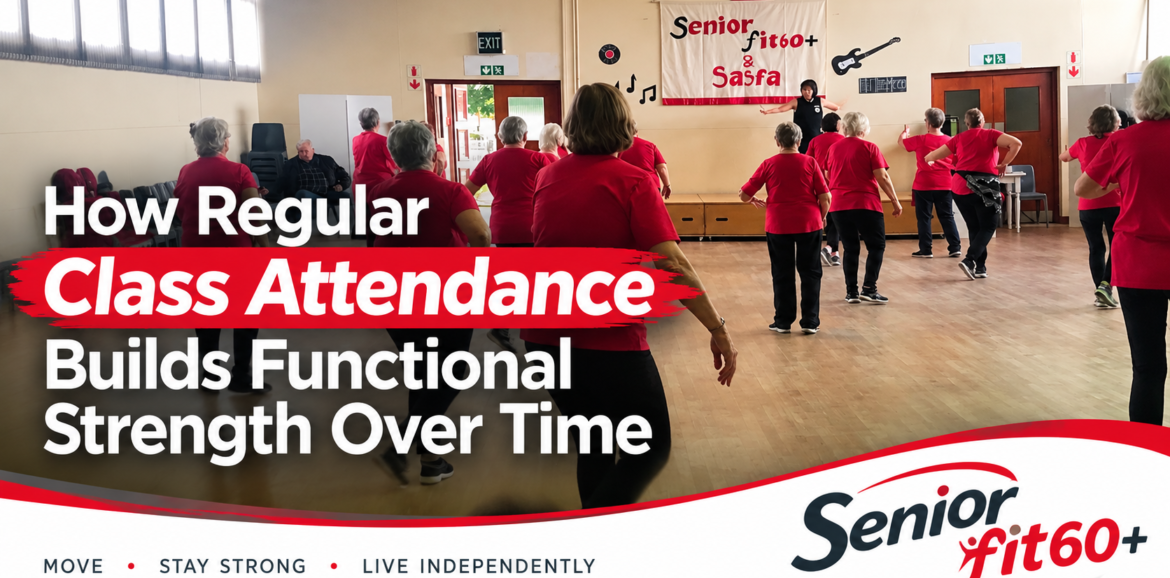
It’s tempting to think of strength training as something that happens in a single session — you show up, you work a muscle, you leave stronger. In reality, strength is built cumulatively, through a physiological process that unfolds over weeks and months of consistent practice. Understanding how this process works explains why regular class attendance, more than any single workout, is what produces real, lasting strength gains for seniors.
What actually happens when muscles adapt
Strength gains follow a fairly predictable adaptation curve, and the early stages look different from what most people expect.
In the first few weeks of a new exercise routine, strength improvements come almost entirely from neural adaptation, not muscle growth. The nervous system becomes more efficient at recruiting existing muscle fibers, improving the coordination between the brain and the muscles being used. This is why beginners — including older adults starting a class for the first time — often notice they can lift more, push harder, or hold a position longer within just a few sessions, well before any visible muscle change has occurred.
Only with continued, regular training does the body begin true muscular adaptation: increased protein synthesis, greater muscle fiber recruitment capacity, and — depending on intensity — gradual increases in muscle cross-sectional area. This second phase typically takes six to twelve weeks of consistent training to become measurable, and it does not happen without repetition. A single class, however good, cannot trigger it.
Why consistency matters more than intensity for seniors
For older adults, this matters more than it might for younger populations. Age-related muscle loss, known as sarcopenia, begins as early as the 30s and accelerates from the 60s onward, with research estimating a loss of roughly 3–8% of muscle mass per decade after 30. Left unaddressed, this loss contributes directly to reduced mobility, higher fall risk, and loss of independence.
The research on resistance training in older adults is consistent on one point: adaptation is dose-dependent on frequency and consistency, not on the intensity of any single session. Studies on structured strength programs for seniors show that participants attending sessions two to three times per week over 10–12 weeks demonstrate significant improvements in muscle strength, functional mobility, and even bone density — while irregular or infrequent attendance shows minimal measurable change, regardless of effort during the sessions attended.
The role of progressive overload
Muscles adapt to the demands placed on them, and once a muscle adjusts to a given level of resistance, further gains require a gradual increase in that demand — a principle called progressive overload. In a class setting, this might mean slightly heavier weights, more resistance from bands, more repetitions, or more complex movement patterns over time. This kind of gradual progression is only possible with regular attendance, since instructors adjust programming class to class based on how participants are responding.
Someone attending sporadically misses this progression entirely, often repeating the same starting-level exercises indefinitely rather than building on prior sessions.
Functional strength, not just muscle size
For seniors, the goal of strength training is rarely about muscle size for its own sake — it’s about functional strength: the ability to rise from a chair unaided, carry groceries, climb stairs, or catch oneself during a stumble. Functional strength depends not just on raw muscle force but on the neuromuscular coordination discussed above, which is itself built through repeated, consistent practice of similar movement patterns.
This is why functional improvements — easier stair climbing, steadier transitions from sitting to standing — are often reported by regular class attendees well before they’d describe themselves as “stronger” in a traditional sense. The nervous system and muscles are adapting together, and that process rewards consistency over occasional high effort.
The takeaway
Strength isn’t built in a single class — it’s built in the accumulation of them. Neural adaptations come first, muscular adaptations follow with sustained repetition, and functional gains in daily life depend on both. Regular attendance isn’t just a scheduling recommendation; it’s the physiological mechanism through which strength training actually works.